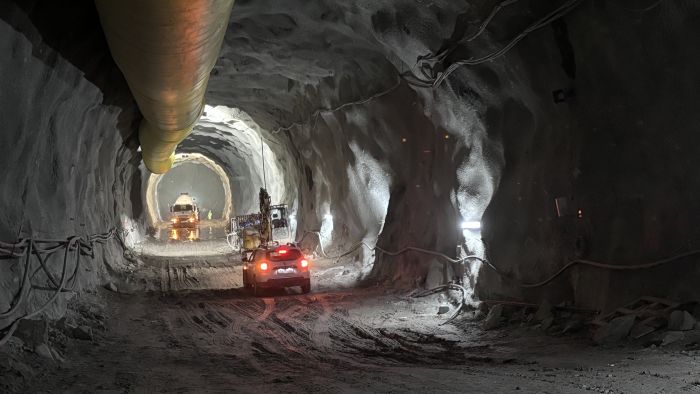
Mining and underground works involve the presence of crystalline silica, a naturally occurring mineral known to be carcinogenic. To address this risk, we have implemented a continuous, real-time monitoring system designed to protect the professionals working on our projects.
Royal Decree 1154/2020 classified Respirable Crystalline Silica (RCS) as a carcinogenic agent, significantly reinforcing employers’ obligations in the field of occupational health and safety. In addition, the General Regulations on Basic Mining Safety Standards require an accredited Administration Collaborating Entity (ECA) to take dust samples every four months at workstations where there is a risk of exposure.
Our Health and Safety Department has gone beyond regulatory requirements by deploying a mobile system for continuous, real-time silica monitoring: the AIR S Silica Monitor.
“Having access to real-time data raises awareness of RCS exposure for both workers and management,” explains David Barreda, Prevention Manager at Sacyr Engineering and Infrastructure in Northern Spain.
Crystalline silica is a very common mineral found in rocks, sand, and soil. It is present in construction materials such as concrete and brick, as well as in activities like mining, quarrying, and construction. When its fine dust particles are inhaled, respirable crystalline silica becomes a serious health hazard, increasing the risk of lung cancer, silicosis, and chronic obstructive pulmonary disease (COPD).


The AIR S Silica Monitor was used during excavation works in the tunnels of the Access to the Outer Port of Langosteira project and will later be deployed during ballast spreading for track installation.
RCS levels can vary significantly depending on the stage of construction, with different exposure levels during blasting, debris removal, and drilling operations.
“This new system allows us to make informed decisions and continue reducing our employees’ exposure to RCS,” says David Barreda.
“The company is committed to protecting both our employees and our subcontractors. They value our concern for their health and the continuous control we maintain over the working environment,” he adds.
How the Monitor Works
The system analyzes multiple parameters in real time to detect RCS, including particle size, symmetry, and a range of unique optical markers characteristic of respirable crystalline silica particles.
At the same time, it uses optical refraction technology combined with light-scattering photometry, analyzing each sampled particle and classifying it according to its identifiable optical properties.
This approach allows the system to detect all forms of RCS — including alpha and beta quartz, cristobalite, and tridymite — across all relevant particle sizes within the respirable fraction.
The resulting data is combined with particle mass analysis to provide measurements in both mg/m³ and particles per liter.
Thanks to this comprehensive information, site management can make timely, well-informed decisions to ensure the safety of everyone working on the project.