The Science of Forest Regeneration

Jesús Alcanda Vergara, a forestry engineer in the Energy area at Sacyr Agua, explains in this article how forests should be properly managed to ensure their maintenance and tree regeneration.
 

Jesús Alcanda

Sacyr Energy

Public opinion naively believes that Spanish forests are neither born, nor do they grow or die: they simply remain. The public assumes forests require no human intervention to ensure their continuity, and that they will always be there, unless they are devoured by summer wildfires.

In the Iberian Peninsula, Forestry—the science dealing with the care and management of forests—is older than the Emperor Trajan. This was documented in the first century by the writer Columella, from Cádiz, in both De Re Rustica ("The Twelve Books of Agriculture") and De Arboribus ("On Trees").

Just as Agronomy is the science of the agro (the field), Forestry (traditionally termed Dasonomy) is the science of the daso (the forest).

Like almost all sciences, forestry has steadily expanded its boundaries of certainty, branching into various specialties. Among the disciplines that make up forest science, two—Silviculture and Forest Management (traditionally known as Dasocracy)—underwent a major systematization of knowledge from the mid-19th century to the late 20th century. It is precisely these two disciplines that are responsible for ensuring that forests successfully regenerate.

Forest Management (Dasocracy, from daso, forest, and cracy, power in the sense of governance or order) is the discipline that deals with the regulation of forest lands. It consists of a suite of techniques designed to organize the forest to ensure its long-term succession.


The analytical techniques of Forest Management guide the forest toward a balanced population pyramid. This means achieving a structure without gaps or inversions, containing all tree age classes distributed in a way that demonstrates equilibrium, proving that the forest is sustainably managed.

The other pillar of forestry, Silviculture, is to the forest what agriculture is to the field: a set of treatments and interventions that ensure maximum vitality, appropriate density, and the protection of the forest stand.

Each age class (e.g., 25 to 50 years) must be represented by a specific number of trees within a given area. In other words, for every age class, there is an optimal canopy density—represented by a range of trees per hectare—which silvicultural practices must achieve so that the trees grow with the greatest possible strength and vigor.


What does Forest Management do to secure the regeneration of the forest shown in Figure 1?


First, it divides the forest land into compartments (or periodic blocks), one for each distinct age class. The compartment containing the oldest age class (trees over 100 years old) is set aside as a biodiversity conservation zone.

A total renewal plan is then applied to the other four compartments, to be executed over the next 100 years. To achieve this, every 25 years, the oldest compartment (aged 75 to 100 years) is designated as the regeneration block.

This means that for 25 years, regeneration cuts will be carried out in this compartment using the "uniform shelterwood system" to open gaps in the canopy, allowing new saplings (the offspring of the surrounding trees) to establish themselves and grow.

It is called a uniform shelterwood system because, over a 25-year period, successive, uniform cuts are made to gradually open up clearings in the regeneration compartment. Meanwhile, in the other three compartments, thinning cuts are applied to adjust tree density to their age. This maintains their vigor and strength, preventing them from growing in overstocked conditions that would significantly weaken them.

After these first 25 years, the regeneration compartment will contain young trees aged between 0 and 25 years (at which point the stand is considered regenerated), while the remaining compartments will have aged by 25 years.

This shelterwood harvesting process is repeated every 25 years in whichever compartment is the oldest at the time, until regeneration cuts have been applied to all four compartments, as shown in the following diagrams, where the first frame represents the "parent forest":


After 100 years, a completely new forest has been established—a descendant of the parent forest shown in the first frame. This is achieved by applying uniform shelterwood regeneration cuts over 25 years in each compartment, while managing the density of the remaining compartments through thinning.

The timber harvested from each of these cuts generates enough revenue to finance subsequent operations, thereby self-funding the forest's regeneration plan.

It is highly inadvisable to apply regeneration cuts to excessively old forest stands. Extremely old trees have a significantly reduced capacity to produce seeds, and the germination rate of those seeds also declines. Leaving the future of a forest in the hands of overmature stands is highly reckless.

When well-meaning individuals oppose the harvesting of trees in a managed forest, in the vast majority of cases, they are unwittingly contributing to the amputation of that forest's future. They are also driving its abandonment—the precursor to devastating wildfires, which are the particular hell of Spanish forests.

But as we all know, the road to hell is paved with good intentions.

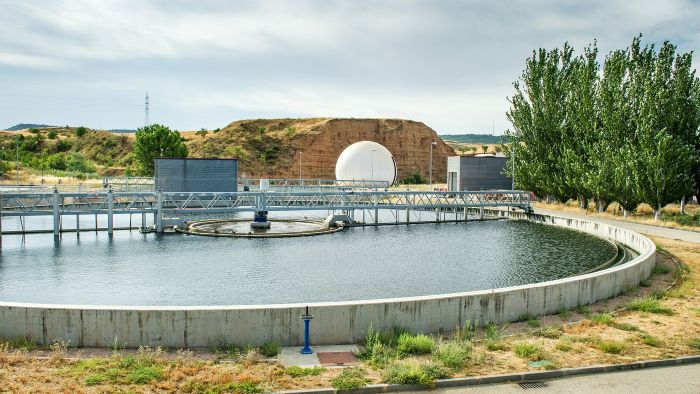
EDAR Guadalajara

EDAR Guadalajara donde se ha realizado la prueba piloto.

Innovation to remove nitrogen in wastewater

Our Denitox project develops a technology that consumes less energy and less organic matter during nitrogen removal in high-load streams in wastewater.

Nitrogen pollution in wastewater is an increasingly prevalent environmental challenge due to industrial, urban, and agricultural activities. Conventional nitrogen removal processes require intensive energy and a sufficient amount of organic matter that is not always available. 

To improve this process and make it more efficient, we are innovating with the Denitox project, which we are developing together with the University of Granada.

"With Denitox, we managed to reduce nitrogen by up to 80% and save energy by up to 50%," explains Elena Campos, head of Technical Support for Sacyr Agua's Treatment Area.

The nitrogen present in surface water bodies can promote uncontrolled algae growth, which can lead to high fish mortality, as has happened in the Mar Menor.


More restrictive European directive


The new European Wastewater Treatment Directive (TARU) drastically reduces the limits of nitrogen in discharge, which in many cases implies a real technological challenge. 

The runoff stream in plants with anaerobic sludge digestion can reach up to 20% of the total nitrogen load that reaches the plant and needs to be retreated after removal. Hence the importance of treating these return streams that have a high nitrogen content, but a low organic matter content. 

With our Denitox technology we can achieve lower nitrogen emissions in the discharge, with high polluting potential, economic savings and the reduction of greenhouse gas emissions.


Pilot test


"We have carried out a pilot test in the Guadalajara treatment plant, which was applied to the return stream of the sludge line, which has a lot of nitrogen. If wastewater normally has between 60 and 80 mg per liter, that stream has 500-1,000 mg per liter. In this study, which was carried out with real water and variable conditions, an 80% reduction was achieved in a stable way," explains Elena.

"Now, the main challenge is to maintain these high efficiencies at room temperature and shorter hydraulic retention times. If we manage to bring it to an industrial scale, Denitox would be a competitive solution for wastewater treatment applicable in many treatment plants to meet nitrogen removal targets," concludes Elena Campos.

Before this test, a stopover was made in the laboratory at the University of Granada, with which we have developed this technology.

"We have optimized the operating conditions, but we need to scale up to a larger size and see how to control the conditions well.


International award in Saudi Arabia


Recently, the Denitox project has won the Global Prize for Innovation in Water (GPIW), organized by the Saudi Water Agency, in the Sustainable Water Production and Environmental Conservation category.

This category values the balance in water supply with the protection of the ecosystem and the reduction of emissions.

Sacyr completes Vanderbilt Beach Road Extension in Florida (U.S.)

  • Sacyr Engineering and Infrastructure has delivered an 11 km road section representing an investment of $159 million (€137 million).
  • This is the company’s thirteenth infrastructure construction project completed in the United States.

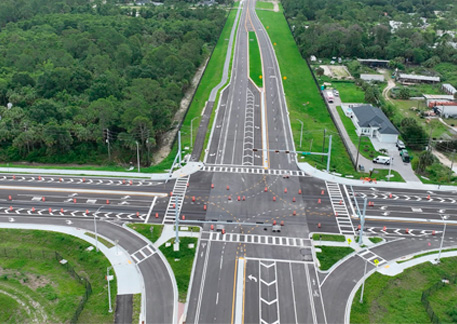
Sacyr has completed construction of the Vanderbilt Beach Road extension in Florida (United States). The 11 km road section, comprising 9.4 km of new construction and 1.6 km of extension of the existing road, was completed two months ahead of contract schedule and had a budget of $159 million (€137 million).

The new corridor, which opened to traffic on June 12, strengthens connectivity and mobility in southwest Florida and supports the region’s urban and economic development.

With Vanderbilt Beach Road, Sacyr has now delivered 13 road projects in the U.S.: nine in Florida and four in Texas.


Sustainable and resilient infrastructure

The Vanderbilt Beach Road extension is a strategic project to improve connectivity and mobility in Collier County, creating new road infrastructure that strengthens the east-west connection in one of Florida’s fastest-growing areas.

The project included the construction of bridge structures and drainage systems designed to meet stringent hydraulic and environmental standards, as well as the coordination and relocation of utilities to support the corridor’s development. It also included paving, lighting, signage and safety systems.

The completion of this project demonstrates Sacyr’s ability to deliver complex infrastructure projects in the U.S. market, driven by innovation and teamwork.

Commitment to infrastructure development in the U.S.

Sacyr began operating in the U.S. in 2018 and has since been awarded 16 projects in the country.

In 2024, Sacyr, as part of Calcasieu Bridge Partners consortium, was awarded its first major transport infrastructure concession contract in the United States: a section of the I-10 highway in Louisiana. The project will require an investment of €3 billion, of which just over €2 billion corresponds to construction.

As part of the objectives set out in its 2024-2027 Strategic Plan, the company will expand its activity in strategic English-speaking markets, including the U.S., Canada, the UK, Ireland and Australia.

0 Folders
4 Documents
María Jesús de Jaén Beltrá

María Jesús de Jaén Beltrá

DIRECTOR

Kind:

Independent

Professional and biographical profile:

Education: Degree in Economics from the University of Alicante and MBA from the University of Houston (USA). She has outstanding certifications, such as the European Financial Advisor (EFA) Certificate, the Expert Certificate in Climate and Renewable Energy Finance by Frankfurt School of Finance & Management GGMBH, the Executive Program in Fintech and Digital Banking by AFI, the COSO Certificate in Internal Control by the AMERICAN INSTITUTE of CPAs and the Certificate of Best Practices in Corporate Governance by the Institute of Directors and Administrators (ICA).

Experience: María Jesús de Jaén has an outstanding track record, with more than 24 years of experience in the international banking sector, mainly in the risk area. She has worked for 16 years in the Santander Group and 8 years in Bankia, in key areas such as Credit Risk, Market Risk and Risk Management in general.

Her subsequent role was Risk Management Consultant at the Green Climate Fund (GCF), a United Nations-created fund for sustainable investments in developing countries based in South Korea.

Currently, she is an Independent Financial/Investment and Risk Consultant, focused on the assessment of project finance transactions from financial, investment and risk criteria. In addition, she works with clients in defining target markets for project finance, specializing in a sustainable "green" economy linked to climate change, providing technical support for structuring, financing and providing financial/investment advisory services.


Date of appointment:

First appointment: June 7, 2018

Last reelection: June 4, 2026

José Joaquín Güell Ampuero

José Joaquín Güell Ampuero

Director

Kind:

Independent

Professional and biographical profile:

Education: Degree in Economics from Harvard (USA) and in Political Science from Sciences Po (Paris, France).

Experience: José Joaquín Güell has extensive experience in investment banking (at Lazard as Managing Director, Santander Investment and Merrill Lynch) in business management (as CFO and Managing Director of Grupo Recoletos) and in financial investment (Investindustrial). He is currently Chairperson of Somos Experiences, a marketing agency specialising in event organisation and Senior Member of the Industrial Advisory Board of Investindustrial.

He has been involved in national and international mergers and acquisitions for more than 20 years and has an extensive background in corporate management and financial advisory, as well as in financial and capital markets.


Date of appointment :

First appointment: June 7, 2018

Last reelection: June 4, 2026

This website uses its own and third-party cookies to improve the user experience and analyze their behavior in order to improve the service offered.
You can consult additional information about the cookies installed on our Cookies policy.

Cookie Settings

Cookie declaration

TECHNIQUES

These cookies are exempt from compliance with article 22.2 of the LSSI in accordance with the recommendations indicated by the European authority on privacy and cookies. In accordance with the above and although configuration, acceptance or denial is not possible, the editor of this website offers information about them in an exercise of transparency with the user.

  • Name: LFR_Session_STATE_*, Provider: Liferay, Purpose: Manages the session as a registered user , Expiration: Session, Type: HTTP

  • Name: GUEST_LANGUAGE_ID, Provider: Liferay, Purpose: Determines the language with which you access , to show the same in the next session, Expiration: 1 year, Type: HTTP

  • Name: ANONYMOUS_USER_ID, Provider: Liferay, Purpose: Manages the session as an unregistered user , Expiration: 1 year, Type: HTTP

  • Name: COOKIE_SUPPORT, Provider: Liferay, Purpose: Identifies that the use of cookies for the operation of the portal, Expiration: 1 year, Type: HTTP

  • Name: JSessionID, Provider: Liferay, Purpose: Manages login and indicates who is using the site, Expiry: Session, Type: HTTP

  • Name: SACYRGDPR, Supplier: Sacyr, Purpose: Used to manage the cookie policy , Expiration: Session, Type: HTTP